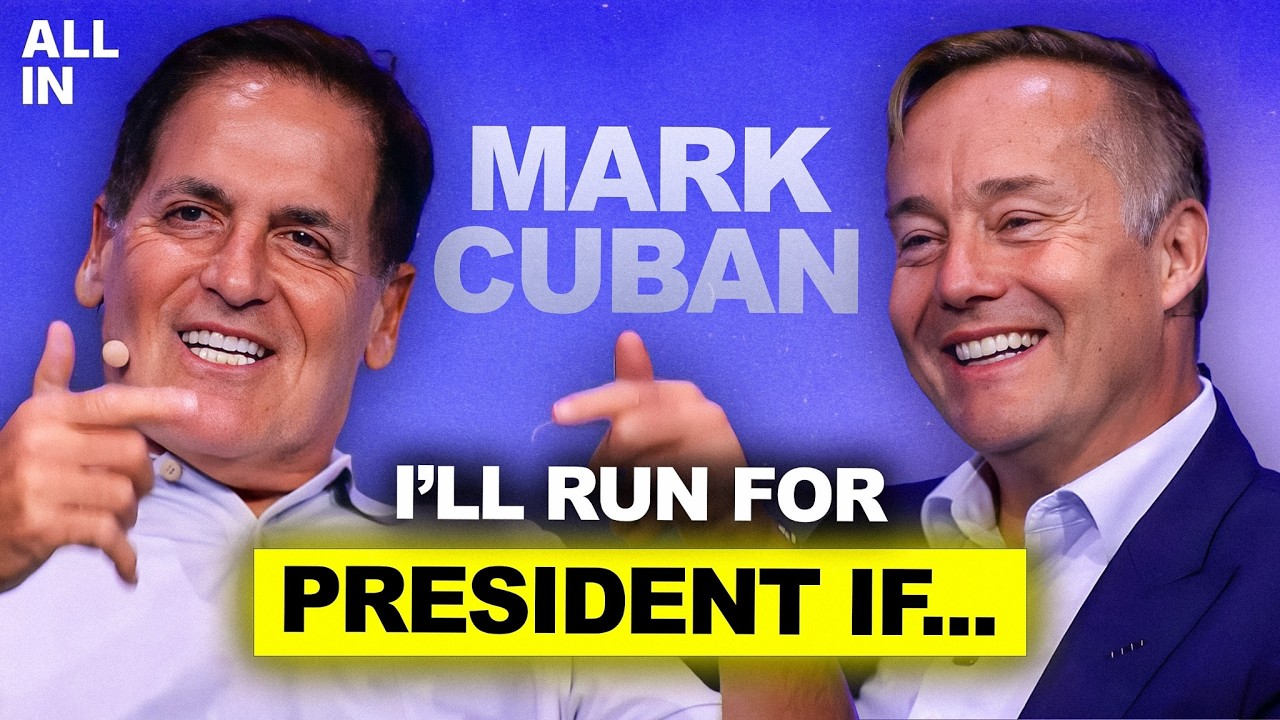

In this conversation, Mark Cuban discusses the AI bubble and its potential consequences, the practical limitations of current AI technology, and broader economic and political trends.
The AI Bubble and Financial Risk
Cuban distinguishes the current AI bubble from the dot-com era, noting that unlike the 1990s, companies aren't going public with absurd valuations and no revenue. However, he argues the bubble could devastate venture capitalists and private equity firms who've invested heavily at inflated entry prices. Market leaders like Google and Meta are borrowing billions for AI infrastructure and capex while planning for "perfection"—a risky approach. Cuban predicts that if AI's price-performance curve improves significantly (similar to how fiber bandwidth once overbuilt suddenly became worthless), many new data centers could become obsolete, potentially being converted to "pickleball courts."
The Reality of AI Implementation
Despite hype about AI replacing workers, Cuban emphasizes that AI is far harder to implement than expected. He notes that while AI excels at narrow tasks like coding and legal work, it struggles with broader enterprise applications. Features people assume should work—like asking an AI to compile a report and email it weekly—don't function reliably. AI requires iterative problem-solving and programming knowledge to implement effectively. Because of these implementation challenges, major tech companies are hiring thousands of engineers to deploy AI systems, contradicting claims that AI is ready to operate autonomously.
Cuban argues that predictions of 50% job losses in white-collar work are premature given employment continues growing and AI literacy is becoming valuable. However, enormous entrepreneurial opportunities exist for people who understand both AI and systems thinking. Tools like Lovable enable entrepreneurs to build software quickly—570,000 applications created weekly—democratizing startup creation worldwide.
The Limitations and Future of AI
Cuban emphasizes that current AI cannot perform basic physical reasoning. If shown a video of a toddler with a sippy cup, AI cannot predict what happens if the cup falls—something a two-year-old understands intuitively. He'd rather have a guide dog than AI when crossing a street blindfolded. World models built on video data represent AI's next frontier, but significant progress remains. Video-based AI applications will require substantially more computational tokens, putting additional pressure on data center buildout.
In healthcare, AI applications like Open Evidence help analyze drug interactions and health patterns, but won't replace doctors—it amplifies physician capability. AI is particularly valuable for health optimization when combined with wearables and regular blood testing.
AI and Truth-Seeking
Cuban argues that large language models' competitive advantage lies in providing accurate information, unlike social media algorithms designed for engagement. As political polarization increases, he believes people will increasingly turn to LLMs for objective answers on policy questions, which will naturally seek truth rather than maximize engagement. This could reduce the impact of algorithmic misinformation by providing a counterbalance.
Political and Economic Observations
Cuban notes that local democratic socialism works differently than national implementation—municipalities with direct accountability must balance budgets. The more significant political trend, he argues, is that whoever controls algorithms influences elections. Young progressive figures like Alexandria Ocasio-Cortez and figures in Michigan, like Trump, have mastered social media's attention economy. He's optimistic about American resilience given presidential term limits, though he criticizes both parties—Democrats catastrophize, while Republicans lack empathy for ordinary citizens.
Regarding geography, Cuban highlights the stark difference between governed regions: Texas spends roughly $12-14,000 per citizen annually versus $67,000 in New York, yet Texans enjoy better quality of life. However, New York contributes more to the federal treasury. He advocates for the business-friendly policies that made him move to Texas, particularly the lack of restrictive building regulations that plague California.